Showing posts with label food. Show all posts

Friday, March 22, 2013

Eating our way through Ambon

We’re told that Ambon is looking for a moniker. We met a woman who had worked to promote Ambon as a tourist destination, who said there was some tension between the candidate slogans of “city of music” and “the waterfront city.” We’re not sure how well either of those apply, because for us Ambon will be remembered as “the city of delicious food”.

There was plenty of time to find local haunts, and we had incredible meals at the little rumah makan (restaurants) near the city market.

Rumah Makan Padang 'Ayah'
Arranging fish servings for the window display

I seem to have a lot of photos like this one, capturing the a great spread just before we attack it. These restaurants actually put all of their dishes on your table, then only charge you for those you eat. Dangerous.

Oh yes
Indonesian food is amazing. Oh my goodness, it is just delicious.

We had to try the Muluku staple called pepeda, a porridge goo made from sago (which is made from the pounded heart of tree trunks- hungry yet?). Our new shoreside family made dinner for us one evening so that we could try it along with a range of regional dishes. It’s a good thing we had the other dishes, because pepeda- as one of our shoreside fam referred to it- has all the eating qualities of glue. But the rest? Amazing. Fresh fish with a spicy soy sauce, a heavily spiced fish stew, and more.

Dinner with Pak Hani
Local treats from pepeda (sago mush) to ikan kuah kuning (fish in a turmeric/almond stew)

Here's a charming image of the glue pepeda. Mmmm. Trees.

Jamie tries pepeda

Some indulgences were decidedly less local. At the fancypants mall, the kids inhaled bowls of frozen yogurt. Mmmm…. And then we discovered that the Indonesian restaurant upstairs made chocolate milkshakes and French fries. Trouble!

I was lucky to have another very memorable cooking lesson on board Totem. A conversation with a new friend about how nutmeg is used for savory cooking turned into a lazy weekend afternoon extravaganza on Totem (with their extended family, natch) so they could provide hands-on instruction. Our recipe: Babi Kecap, pork in a rich sauce. It’s somewhat unusual in that pork is less commonly eaten in this predominantly Muslim country, but this region has a significant Christian population...although it took some work to track down the pork. I did the grocery shopping, they brought the knowledge (and their families), and we made a day of it. More, please!

Babi kecap
My fantastic cooking teachers, Ina and Erlyna 

Babi Kecap

2 kg fatty pork (you do not buy "cuts" in the public market. You get a lump of meat)
~ 1/3 c kecap manis (sweet Indonesian soy sauce: sorry, no substitute)
1 Tbsp soy sauce
Salt, oil
~20 cloves garlic
1 med yellow onion
1 bunch green onions / scallions
1 to 2 whole nutmegs

Wash pork, drain well, and cut it into bit-sized pieces. Set aside in a bowl. Add about a tablespoon each of kecap manis and soy sauce, a generous pinch of salt, and about 10 cloves of minced garlic. Stir and let stand for 15-30 minutes.

Chop half of onion and mince 10 cloves of garlic. Fry in a bit of oil (we used coconut) until fragrant, then add pork. Grate in lots of nutmeg- we used about half of a large nut- than splash on a couple of tablespoons of kecap manis. Eventually this will color the sauce to a dark brown color.

Stir over medium heat. My cooking teachers periodically added a bit more kecap manis until they were satisfied with the color and quantity of the sauce. As the pork cooked and rendered fat, this became like a very dark runny caramel.

When pork is nearly done, grate in more nutmeg- we used almost a whole clove. When it is tender and nearly complete, add the other half of the onion (rough chopped into crescent slivers) and scallions (chopped). Cook until these are wilted and mixed in. Cool slightly, then serve with rice.

We ate the entire batch before I could get an "after" photo, and trust me, "before" photos of raw pork just aren't that exciting. I’m told this is even more delicious the second day, but we haven’t made it last that long yet!

New friends
Ina, Erlyna and relatives heading home after our afternoon on Totem

Wednesday, November 7, 2012

How to cook yams, with cultural lessons on the side

Yams and coconut are diet staples where we have been cruising in southeast Papua New Guinea. We have traded for many, but my first attempts at preparing them weren’t very interesting. One of the first women I met on Panapompom Island, Wendy, came on board to help me work out the secrets one afternoon.
The first step is to peel the rough skin from the yams. Before we began paring, she pointed out that the trader who brought these to me was giving away her seed yams. This time of year (September/October) is planting season, so she cut off the top couple of inches from each yam and reserved them to be replanted. Our lesson diverged into a long tangent on growing yams: the many varities, how gardens are owned, and who works in them.

Wendy's yam lesson-1

Wendy used a paring knife she’d brought in her bag. Actually, she’d probably love to have a proper paring knife. Like a lot of knives we’ve seen, this was just a broken blade which had long since been parted from its handle, but served the purpose.

Next, yams were cut into similarly sized pieces (about 1 x 2 inch chunks) and put in a pot, to which about an inch of water was added. She said we should put some salt in. I asked if she used seawater, since anytime we can use a little seawater helps conserve our fresh water supply. “Of course!” was the reply- and felt a little like an idiot. Her potable water is collected from rain during the wet season, so her method conserves fresh as much as possible: it’s a precious resource. Of course. The pot was put on to simmer.

What makes these yams really good is fresh coconut milk. This is probably where my yams prepared on board fell short compared to what we tasted on shore. Wendy laughed at my cleaver and suggested I needed a "proper” bush knife to crack them.  She made quick work of getting a mature coconut cracked, and the meat cut out in chunks, but it was minutes instead of seconds with the right tools. Getting meat out of a coconut is a lot harder than it sounds. I’m already fascinated with how everyone from about the age of two seems to carry these big machetes around, and have another reason now to seek out a bush knife. Meanwhile, I’m collecting photographic evidence of PNG toddlers as knife experts.

Next the coconut meat is grated. Once again, we are lacking island-style tools. Most homes have a coconut scraper that looks a little like a footstool, with a wicked looking piece of metal off the end. Half of a coconut is inverted over the metal bit, and with some vigorous rubbing the meat inside is quickly turned into a pile of fine shreds. Our grater didn’t work as efficiently or uniformly, but Siobhan helped us to get the job done.

Next, the grated coconut meat is put into a colander or strainer over the yams. All Wendy really does is squeeze it by the handful to eke out a few tablespoons of rich milk, but a little bit of water helps. She didn’t do much more than shake a wet hand over the top of the pile to get enough.

Wendy's yam lesson-5

I couldn’t resist breaking out a can of coconut milk, and showing her how we would normally acquire the creamy liquid. The very idea is anathema: we did a taste test, and of course, there’s no comparison to the fresh stuff. In the context of her home, though, Wendy was fascinated. Coconuts litter the ground, but canned goods are only acquired at relatively great expense and by traveling to another island. It embarrassed me, to be honest, and I quickly regretted grabbing the can from a pantry locker- but she just laughed it off.

The yams were tested periodically with a fork, and were cooked through in about 20 minutes. Scooped out onto a plate, we snacked on them as soon as they were cool enough to touch. Yams are cooked and eaten throughout the day. Children poking their heads out see the “dim dim” clutch them, and like children everywhere, don’t find a mouthful of fluffy yam to be remotely an obstacle for talking.

We’ve eaten yams like these on almost every stop so far in PNG. Even if I weren’t already a little obsessed with what we eat, it’s hard not to be drawn to understand these mainstays of a subsistence lifestyle.  The lessons I learned along the way from my afternoon with Wendy underscore how food offers windows into a culture.

Wendy's yam lesson-6

Wendy and I had also talked about how to find new ways to engage with cruisers to her home of Panapompom island. She and her neighbors are interested in trading, and curious to meet people who come to visit. But visiting boats don’t always want or need what islanders have to sell. Bringing them a service to trade, like a cooking lesson, is a different way of thinking. It gets cruisers and islanders into the same space and talking together: anything that can elevate the conversation from how many papayas for a t-shirt has got to be good! Even if the lessons are just be about cooking yams, at the absolute minimum it’s almost impossible not to make a friend, and learn more about the beautiful and friendly place we’re visiting.

Wednesday, August 15, 2012

Aussieisms: the Tim Tam Slam

We were first introduced to the Tim Tam Slam by our friends on s/v Mulan during the Pacific crossing in 2010. It’s fair to say that the Australian Tim Tam “biscuit” (as cookies here are called) has become a favorite treat on Totem. A few extra “packets” (only an American would call them packages) are provisioned and stashed away before our departure.
TimTams
Mairen demonstrates the Tim Tam Slam, a preferred method for enjoying the cookie. It’s best for warming up after a chilly snorkel.

First, bite off diagonal corners of a biscuit.
Slam1
Next, dip one of the bitten off corners into your tasty beverage. Mairen has hot cocoa.
Slam2
Now, use that Tim Tam like a straw. Yes, like a straw. It works, mostly.
Slam3
When you feel the biscuit getting a little mushy, quick, pull it out of the cocoa and stop drinking!
Slam4
Eat that biscuit. It’s going to be a super chocolatey mushy delight.
Slam5
You’re welcome.

Saturday, July 7, 2012

Canning on board: papaya chutney

Some amount of eating from cans is a reality for most cruising boats. Between limited refrigeration, passage making (19 days at sea to the Marquesas!), and minimal resources available in some of our destinations- it's necessary to keep our bodies happily fueled.

removing labels from cans
Provisioning staples for six months - Mexico, 2010

Much better than buying commercially canned food, though, is canning your own. No BPA. No unpronounceables. So much more tasty. The delicious conundrum of whether to use that peach butter for toast, or a fuzzy navel.

Canning food brings with it childhood memories and associations with people I love- making blackberry jam with my grandmother, bringing home pickles from Jamie's mother. Borne from necessity, it became nourishment for the soul as well as the body.

And just as our grandmothers know, it's also a great way to take advantage of local bounty. This is what got me back into canning when we were in Mexico: mountains of gorgeous fresh papayas, coupled with the prospect of weeks at sea during our passage to French Polynesia. The fact that we would face limited (and expensive) food when we arrived didn't help. I made several large batches of papaya chutney, and it turned out to be the perfect addition to kick up many meals on board.

Later this year, we'll be spending a few months sailing through Papua New Guinea. In almost every place we expect to stop, there aren't going to be any grocery stores. We'll trade for fresh produce, but to keep things interesting (and at least a tiny bit predictable), I'll be getting busy canning before we leave.

Good news for me: papayas will be coming into season here just in time for our departure!

Totem's Papaya chutney
1 Tbsp minced garlic
2 Tbsp finely chopped ginger
Grated rind of an orange
1 c vinegar
1 ½ c sugar
Spice it up: pinch in cloves, cardamom, cinnamon
Spice it up a little more: dash in hot sauce to taste
1 large, firm papaya, peeled and chopped

In a saucepan, combine garlic, ginger, orange rind, vinegar and sugar. Bring to a boil, then add remaining ingredients. Simmer until sauce thickens. I process these minimally, similar to the method here.

Thursday, February 16, 2012

Sailing the Farm

One of my favorite books I read during the years we only anticipated cruising was Ken Neumeyer's Sailing the Farm. Long out of print, the contents live somewhere between back-to-the-land movements and the anti-establishment ideals of the late 60s counterculture. It's packed full of ideas for growing your own food aboard and foraging from the ocean, and how to survive as your own floating island, living outside the constraints of conventional society. At the time, the yard around our house produced everything from pumpkins and tomatoes to strawberries and herbs, and I loved the idea I could keep a portion of our family's diet coming from the work of our own hands after we moved aboard.

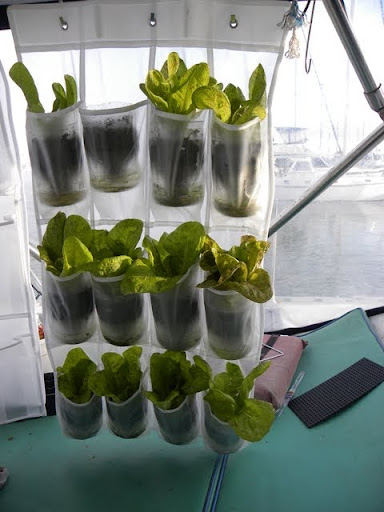
Lettuce growing on  Laureen and Jason's cat
That ideal did not take into account the practical reality of an itinerant cruising life. Coming across the Pacific, we hopped countries at intervals from a few weeks to a few months. Foreign quarantine officials generally don't take kindly to you bringing live plants in, so there was never time for growing anything of our own beyond sprouts. Saltwater spray isn't kind to growing plants either.


Spending extended time in one country changes all that. Last year, we had an amazing community garden nearby to literally and figuratively feed us. Now it's time to bring it home: I'm ready to start boat gardening. It's just a question of what, and where. 


There are spectacular examples of boatsteading, like the hydroponic system used by the Plastiki expedition. I need something a little more achievable than that (I'm not up to welding), and my friend Laureen has a spectacular setup for growing plants on her catamaran that looks like the trick. 


If I can work out the right space for this, I think it's a great model. She's got an old over-the-door shoe rack and recycles plastic bottles into self-watering pots for plants. Water is wicked up from the base, making efficient use of precious fresh water. There's a good, more detailed DIY for making self-watering pots like these on the Green is Universal blog. Achievable, yes!


Vertical garden
Thanks to the Merlin kids for providing a little scale here.
And then... there's the appeal of something I can start by just buying and hanging up, like this cool find at last weekend's market.


Tubes of UV-resistant plastic (insert a groan...but I think the plastic here is probably unavoidable), filled with a lightweight growing mix. Seedlings are inserted in slits through the sides. She had samples growing everything from herbs to tomatoes.


Next, finding seedlings or seeds for plants suited to the Australian climate: lettuce that doesn't need tons of shade, and drought tolerant varieties that suit our desire for minimizing freshwater use. They're out there, and once again, the weekends markets are my friend here. Lettuce that grows in Darwin? Drought tolerant tomatoes? Yes, and yes.


Jamie likes to remind me how I seemed to kill potted herbs in Mexico. ... so boat gardening had been off the agenda for a while. But I've had a little basil friend for almost two months ago. A cheap, overplanted supermarket pot that's so root bound it shouldn't have lasted more than a few weeks. We're still eating from it...I'll take that as a sign. Time to start gardening again.

Monday, January 23, 2012

A well fed crew is a happy crew

Among the cruising truths I had to relearn was how important it is to have easy meals prepared in advance.

Hazards of galley cooking
The stove was gimbaled, but apparently still not level...lopsided cake is a hazard of galley cooking.

People, this is cruising 101. I'm a little embarrassed to admit that I glossed completely over it in our preparation. Apparently, I really thought I'd be cooking pasta, dicing tomatoes and cutting up pineapples as we worked our way up the coast.

The first leg up to Pittwater was motoring in flat water. Easy. But Pittwater to Port Stephens was such a roller coaster ride, the best I could do was throw  a bunch of veggies, lentils and some couscous in the pressure cooker with water and make curry mush. It was good enough, and it stuck to bowls (hot, liquid soups are a menace to eat in a seaway!).

At least it only took one leg for me to relearn this. Before we left Port Stephens, I cooked up a storm. We had a pumpkin cake, banana bread, brownies, cornbread, chili, baked beans, prepared salads and more. Minimal effort (and no boiling water!) required.

Monday, December 26, 2011

Aussieisms: Cherries are for Christmas

We plunked ourselves down around the community tables in the marina last Friday for our weekly barbecue. The informal "it's going to happen anyway" gathering is comforting in its unplanned simplicity...we love this regular reconnection with our boaty neighbors.

Plates of munchies were around. Jacqui brought out a bowl full of fresh cherries, sighed, and said "now it's really Christmas." Cherries? Christmas? Yes, if you live in Australia.

cherries = Christmas

Validated the cherries=Christmas theory at Christmas dinner with Aussie friends... apparently it's true. Being just after the the midsummer solstice...of course! Why not?

Sunday, December 11, 2011

Aussieisms: the sausage sizzle

Anyone remember the Tourism Australia campaign from way back where Paul (Crocodile Dundee) Hogan said he'd put "another shrimp on the barbie" for you? Aussies would never use the word shrimp: here they are prawns, thankyouverymuch. But they do love their barbies, and what you'll find most often on an Aussie barbie is a sausage (also known as a snag or at least 3 other slang terms that my children know better than I do).

As far as I know, the Sausage Sizzle is a uniquely Australian phenomenon. They are fundraisers, a kind of bake-sale-meets-barbecue event. We've seen them raising money for everything from childcare centers to cancer foundations. On election days, there are even Sausage Sizzles at polling stations (finding a captive audience for fundraising: Aussies are required to vote).

the aussie sausage sizzle

On weekends, pop-up barbecue stalls at the local equivalent of Home Depot grill sausages, onions, and serve them on a slice of bread. Tomato sauce (ketchup) and H&P sauce (which isn't exactly steak sauce or barbecue sauce but a little bit of each) are avaialble to squeeze on top.

the aussie sausage sizzle

Like most fast greasy food, it smells incredible. There is huge expectation for the first bite (you probably went out erranding on little more than a cup of coffee). And, like most fast greasy food, your gut tells you to regret the entire event soon after the last bite is finished.

Wednesday, October 26, 2011

Community garden counterpoint

Here's another reason I'm so grateful for our commuity garden.The organic produce available in our area looks like this:

this is "organic" in Sydney

Hello, masses of unnecessary plastic packaging. You too, shrink-wrapped food. Not too pleased to see you, styrofoam trays. Whoa, $6.50 for a l'il bunch of green beans? or TWO heads of garlic? For friends at home, Aussie and US currency is about 1:1. Food here is more expensive, but those prices are almost criminal.

Yeah. Not so appealing. There are some CSAs, but they don't deliver- not really an option for us carless folks. There are a few delivery services for organic food, so we gave that a try. Here's what a $60 box (plus  $8.50 delivery) of mixed fruit/veggies looks like:

Organic delivery box
One ear of corn? One bitty avocado? ugh.  Taste was not up to standard.


The costs are crazy. I don't mind paying more- quite a bit more!- for organic- but on a per-kilogram basis, I benchmarked the delivery services at three times the cost of the grocery store. That's too rich for us.

So yes- thank goodness we have the garden! Check out this cauliflower. It is BIGGER THAN HIS HEAD. Oh, it was tasty...
bigger than his head!

Wednesday, October 19, 2011

Vegetable porn

There was plenty of fruit in the Marquesas, but precious few fresh veggies beyond long-storage varieties. If you wanted, you could pay $12 for a plastic-sealed bag of rapidly ageing lettuce in the Tuamotus. Through most of the islands, familiar fresh veggies were scarce. It was fun to work out things to do with the omnipresent starchy tubers and hardier new greens, but we crave what we cannot have.

Maybe that's another reason why I'm so enamored of the gorgeous produce coming from our community garden effort. Here's a peek at the current bounty... or at least the best I can give with the lousy camera that's built into my phone.

Not the garden glamor queens, but possibly my favorite... fava beans. A little time consuming to prepare but worth every bit... if I make these for you, it means I love you.
fava beans = love


Gorgeous PURPLE broccoli. With little yellow flowers. Have you ever seen prettier broccoli? Didn't think so. Oh and then there's the chard and some lettuce and a couple of forgotten swedes in the pretty basket...
purple broccoli


Kale, celery, carrots, radishes, beets, green onions. Take me now.
bounty

Mind blowing color. Stems on the chard are even more vibrant than my lame camera phone suggests.
fluorescent chard

Mind you, it is only mid-springtime Sydney right now. Tomato season is so close, I can almost taste it!


Friday, October 14, 2011

Feed the body, feed the soul

Something I've missed about living on land is having a garden. Oh, sure, you can put pots on the deck for boat style patio gardening- but that's highly impractical while cruising. Aside from the harsh environment (salt spray is foe to the hardiest!), quarantine in most countries generally won't welcome live plants.

Thanks to a friend at work with an interest in permaculture, we became connected to a community garden in our area.

community garden
Many moons ago: radishes lining the bed of Tuscan kale.

It's a little different from the usual plot system in Seattle "P-Patch" or most other community gardens. This operates entirely as a collective: there is no Yours and Mine. Participants share all the work, and share everything produced. On Sunday mornings, we take the bus to the other side of our district and meet up with other volunteers around 10. We work until about 1, with a generous break for midday tea. As we get ready to depart, the fruits, and herbs which were harvested are on a table, and we each take what we need, with an eye on ensuring something for everyone. A few dollars contributed each time to help cover expenses, which is also funded by the North Sydney Community Council

We've had the obvious benefit: really, really good food. It's just so very much more than this, though.

It's a community of truly lovely people, who have been a gift to get to know. Carol, below, is our matriarch.

helping pull cauliflower
Pulling out cauliflower is hard work!

The break for tea usually includes scones or other homemade goodies from a member. We make tea from a mix of herbs in the garden: kaffir lime leaves, lemon thyme, sage, or whatever is handy.

tea time at the garden

It's when we sit with our fellow gardeners, and chew on issues bigger than the cutworm crisis over a cuppa.

garden community

The kids claim teatime is their favorite part, but I know it's more than that, too. It's about how proud Niall is of the meaningful contributions he makes- putting nets over our tamarillo trees, or constructing the tomato trellis. How Mairen loves ferreting every last little cutworm in a bed, and dedicating it to a bucket for some hungry chickens. Siobhan's pride in having what see sees as utter and complete ownership of the eggplant harvest (although truly, she sees fruits we missed completely).

tomato trellis

And then, of course, there are usually dogs.

there are usually dogs
Few things better than an adoring canine fix.

Over the last nine months, the children have been able to harvest vegetables from plants that they started from seeds. Really understanding how to produce your own food is a valuable life skill. They also know what real, good, organic produce should look like... and they compare that to what we see in the supermarket.

So much more nourishment than you'd think, from a pile of fresh greens.

early spring haul
Siobhan preps the haul of an early spring harvest at home: cauliflower, peas, lettuce, parsnips, kale, pansies, rutabaga, chard, lots of herbs... I think there's a daikon hiding in there, too.

Friday, October 15, 2010

Thinking with my stomach

I have to admit, much the cooking on board is lately has been pretty uninteresting. As we work across the Pacific islands, we commonly go in spurts of a couple of weeks without access to fresh produce. There are plenty of long term staples on board, but there's really no good substitute for a crunchy fresh veggie or ripe juicy fruit. Resorting to canned versions of either is a desperation measure.

Instead, so we grow sprouts in order to have anything resembling a crunchy fresh veggie. We buy greener tomatoes when we can find them, so they'll be getting ready to eat when other freshies are eaten or past their prime. We try to have fruit on hand that will last.

Before cruising, we were spoiled with our access to excellent food. We had a spectacular diet based on vegetables from a CSA (Chris Lewellyn, I miss you!), meat sourced from farmers we knew (Bruce, will you and Debbie come visit us in Australia?), and staples from an organic buying club (*sniff* those days are distant). Any gaps or cravings could be easily filled by a family-owned neighborhood grocery store that offered a broad spectrum of what the world has to offer.

After years of knowing the producer for the majority of our meat- something I think is important- I was reluctant to switch to "mystery source meat" in Mexico. We tried being vegetarian for a while, and it was OK until we didn't have much access to fresh vegetables in the sparsely populated Sea of Cortez last summer. We have better access in the Pacific islands, but opportunities to purchase can be spaced out by weeks. Except in a couple of locales (like Tahiti, where you can get almost anything you want- for a price) the variety of produce and grains can often be extremely limited, anyway .

If I sound a little glass half empty, I'm probably just down because I recently had to throw out all the remaining flour on board. We make our own bread, so this is kind of a big deal. But we found bugs. Lots of bugs. Flour with the odd weevil is one thing... flour that is alive with larvae is another. Then, it was in the pancake mix- my backup (besides pancakes, it makes excellent fry bread and can be used for some muffins and similar quick bread type baked goods).

It's not all bad. Far from it! When we do get to population centers with markets, we are eating gorgeous, fresh, and local. I've got a pile of pictures from the market in Port Vila to get uploaded and hopefully share tomorrow.

Also, our provisioning in Mexico- which we are *just now*, almost seven months later, finishing up- went really well. As we use up the last of many of our Mexican-purchased goods from the spring, I've been noodling on long-term provisioning lately. Got questions? Send me an email, or comment below.

fresh peanut bundles

fresh peanut bundles in the Port Vila market

Saturday, April 3, 2010

Rendezvous in the big blue

24 hour run: 141 nautical miles
Distance to go: lots. still not thinking about it.
Conditions: broad reaching in 12 knots

We're legging out our distance from land and are feeling very in touch with the vast expanse that is the Pacific. With nothing but water as far as we can see, it sometimes feels like we're just a waterbug on the mountainous ripples of ocean swells.

What a pleasant surprise it was, then, to encounter s/v Escapade on our second day out. They left about 8 hours ahead of us on the morning of April 1st, and we ended up in visual range at midday on the 2nd- given the square miles we are traversing, it is nothing short of remarkable that this occurred. We had fun catching up over the radio, then signed off to continue our near-pass. Not long after, Escapade hailed us again- they'd caught a 30 lb yellowfin tuna. The big fish was more than Jim and Brendan could eat and store, so they asked- did we want any? Heck yes!

A boat-to-boat transfer was arranged. They slowed farther, we powered up and went toward them, then we stood off and watched as the swells played with our bobbing vessels and wondered how to safely get close enough. The solution in the end was to practice the long toss with goods in a ziploc bag. Slabs of tuna came flying into our cockpit, and we sent a bag with slices of pound cake skittering across their dodger.

What a feast we had! Lunch was delicious sashimi- it really doesn't get much fresher than that. The children requested ramen noodles, with slices of tuna quickly "cooked" when placed on top of a steaming bowl. We had tuna steaks for dinner tonight- sesame seed crusted, and seared for about a minute. It melts in your mouth and is a little bit of pure heaven. Siobhan calls it "sushimi", we call it delicious.

It's unlikely we'll see another boat from the fleet until we arrive. Our friends on Capaz are not far away- we followed their masthead light last night- but VHF radio and visual range are quickly lost. The daily radio nets become even more important, as a time to catch up with friends and report in to the fleet.

------------------------------------------------
Posted via radio: we have no internet access

Sunday, March 21, 2010

Salsa, salsa, or salsa?


We're preparing ourselves and Totem for our biggest journey together yet, the passage from Mexico to French Polynesia. Over the last few months, we've felt a little smug about our general state of preparation: no question about it, Totem is ready to cross an ocean. This may help explain the karmic whiplash which has put sucked us into a range of suddenly urgent, last minute projects...

...like which salsa to choose.


We have heard over and over from fellow cruisers that if there's something we want to have while we're in the South Pacific, we should bring it with us. While I am sure that fresh baguettes with New Zealand butter will quickly become a Totem favorite, it's hard to imagine giving up our Mexican routine for salsa with, well, just about everything. Fresh tomatoes will be unavailable or a king's ransom, so we're stocking up on these instead, and if we're going to have a case on board... we better like it!

Besides, what better way to formally evaluate the local salsa brands than a blind taste test over sundowners with our fellow cruisers?

Discussing salsa merits over a margarita was delightful. Comparing fruit cocktail during a bouncy ride across Banderas bay was not. There's just something not right about eating canned fruit. It's right up there on the scale of personal appeal with canned peas or asparagus. Ick. But again...there will be times, we are told, when we will be very happy to have depth in our provisions and not need to rely on what we can find upon our arrival. On the other hand: it's very difficult to imagine consuming or enjoying something which simply has not been a part of our diet before.

We don't know exactly when we'll depart on our crossing...watch this space for updates!

Tuesday, February 16, 2010

Provisioning adventures

Getting food to our home is a little more complicated than it used to be.

DSC_7262
Frutas y verduras, Zihuatanejo

First, of course, the obvious- we don't have a car. We get everywhere on foot, sometimes aided by buses, on rare occasions by a ride in a taxi or a friend's car. But consider the quantity of food needed to keep our family of five fueled, and carrying the milk and produce to support them. Daunting! I can come home from one of these adventures looking like a pack mule.

Then, there's the simplicity of having a single store to visit. Sometimes it is the case in Mexico that I can do all of a week's shopping- a provisioning run, in boat-speak- at a single store. But in many towns, this isn't an option: there are no large supermarkets. And even when there are, to be honest, it's the second to the preferred choice to stocking up at individual vendors, who typically have higher quality products in their niche area. It's a mode of purchasing food which has been pretty much lost back in the states, with our quality of eating as the casualty. A given shopping jaunt here would typically the tortilleria (what did we do before we had fresh tortillas in our diet?), the panaderia (bakery... delicious little bolillo rolls, perfect for sandwiches, and the occasional treat of sweet pan dulce), the carneceria (the butcher- who will grind or cut to order; sometimes, it takes visiting multiple carnecerias, as they will specialize in different animals as well), the fruteria (for fresh produce), and then a more all-purpose tienda for staples like rice, beans, or cooking oil.

cheese shop
Believe it or not, this is a little store selling cheese from the family goats.

Many of these are doubled up: the butcher often has fresh cheeses, and an all-purpose-tienda may be the only place in town for produce and staples.

the "everything" store
yes, that's a grocery store...and if what you want is not there, you have over 100 miles to get to the next one.

It's not difficult, just a little more complicated, and a lot more time consuming. We learn to work with what we have, since running off to get a forgotten ingredient is highly impractical.

Last week, shopping in Zihuatanejo, I had local help and practically flew through what should have been an all-day adventure. Noemi owns a small restaurant in town, and we had enjoyed dinner at her cocina economica the night before. When I told her we planned to go to the public market the next day, she wouldn't hear of it. They'd charge too much! Their produce isn't good enough! She knows a better place for chickens! OK, OK, OK... so, happily, we trundled off with Noemi the next day.

What a difference she made! Visiting the full complement of tiendas (except a baker, which I didn't seem to miss) with Noemi meant flying through. No wandering between stalls in a big market, wondering where to buy what. We went to her hand-picked butcher (two, actually- she had preferences for where to buy beef and pork vs chicken) and produce shops. Orders were made and paid for, help was rallied, and we had her restaurateur's negotiated prices. I rattled off an endless list at the produce shop, having willing help. If they didn't have what I was looking for (dried coconut was one), he ran down the street and sourced it at cost from another vendor. This was a young guy who could actually pick avocados for me: four to eat today or tomorrow, and six more that will last a week.

great veggies here...I loaded up
Thanks to Noemi, our orders were DELIVERED. Note the tricycle at the bottom of the photo.

I was able to provision the boat with seven people on board (our friends Jim and Diana are here) for over a week in under three hours, round trip. This might not sound like much, but it was a huge achievement in our world.

Diana, Noemi & Jim

Noemi with Jim & Diana...she immediately remembered them, although it's been 15 years since they were in Zihuatanejo on their boat.

Friday, January 29, 2010

Comfort food

Mexican power breakfast: Chilaquiles

I try to restrain myself, really, but I’m incredibly food centric. What we eat, where it comes from, the literal flavors of an experience… after my family, it would be fair to say that my life revolves around food.

Living in Mexico this past year has meant a world of new things to try, new flavors to differentiate, new techniques to understand.

It has also meant missing old favorites. I remember in high school, when we moved to Taiwan- and said goodbye to peanut butter and cheese which was more than a “food product”. When we returned to the states, a simple sharp cheddar never tasted so good!

Before we left to go cruising, my morning routine was a latte. Jamie made it for me every morning, and I’d carry it to the ferry in a steaming travel mug. It was comfort in a cup. The familiar comfort flavors I crave now? A few bites of good dark chocolate, every now and then. (My parents sent a bar of 70% chocolate for my birthday last month. Not that I worried, but I think this is proof they truly love me). A shaved bit of reggiano on a perfectly ripe tomato slice (plenty of gorgeous tomatoes around here, but you can forget the cheese. It’s… different). Basil. Lamb. Organic anything. A childhood friend of mind has a food blog, and I like to torture myself by reading about the exquisite kitchen adventures she has with her children… the ingredients I dream about finding by accident in a Mexican tienda... usually nothing we can come close to replicating down here.

Here, though, I’ve discovered a fantastic new comfort food: chilaquiles. It’s basically stale tortillas, cooked in an enchilada sauce, usually served with topped with sunny-side up eggs (if it’s for breakfast) or shredded chicken (any other time of day). A dollop of crema (which is somewhere between crème fraiche and sour cream), a sprinkle of chopped cilantro, and you have the makings of a delicious, comfort meal. Better yet: I believe I may have hooked the whole family with this new, spicier take on comfort food.

I’m told that Mexican women are supposed to learn how to make this before they get married. It’s got to be the best way to use leftover tortillas around (and we do accumulate them sometimes- those warm, fresh pillows of masa can get stale fast).

It’s ironic: in looking for a new comfort food, I think I’ve found something I’ll be hard pressed to replicate after we’ve left Mexico. I wonder what will be next?