Wednesday, April 3, 2013

Waiting for weather in Kota Saparua


We had a mostly grey week of watching for weather to sail down to the Banda islands. The anchorage off the main town was much more flat and secure, so we had a comfortable place to wait and felt in no hurry.

Saturday is the big market day. Best to go early! I was hoping to score some chicken… the earlier you buy, the fewer flies come with your purchase. Siobhan tagged along and caused quite a stir.

This lady decided to kidnap her and show her off to friends. All in good fun.

Saparua's Saturday market
Siobhan is being held at the rear right of the picture

Everyone is always watching Siobhan.

Saparua's Saturday market

I just like watching all the market goods: like these gorgeous chilies, and the mountains of sago.

Saparua's Saturday market
look: NO PLASTIC PACKAGING! It can be done.

Most days, the village was a lot slower, and a lot sleepier.

Kota Saparua

Dried cloves in a shop wait to be packed and shipped.

Dried cloves

A small warung, the ubiquitous little restaurants of just a few tables (or even just one).

Saparua warung

Salt for sale.

sea salt

Monday, April 1, 2013

It’s all your point of view

We nestled into the south harbor of Saparua, right in front of an imposing fort. Fort Duurstede was built by the Dutch in the 1670s.

aiming at Totem

The ruins were interesting, but other than a guest book and a guy collecting fees there was little to illuminate us about what we saw. We can speculate about the trace evidence of jail cells and the sanitation, but wish we could learn more.

jail cells
that would be the jail

indoor plumbing!
that would be the facilities

The museum adjacent did have a series of dioramas (with annotations in both Indonesian and English) depicting the 19th century uprising that took place there. In the early 1800s, it was occupied by the English, then turned over to Dutch as holdings were consolidated with a bit of colonial horse trading. The local community didn’t want the Dutch back, and one man led a successful attack to take over the fort. He was given the name “Pattimura,” which means big heart, because he didn’t kill all the Dutch within- he spared the Resident’s young son.

The museum tells almost nothing about the history, purpose, or structures remaining of the fort. It is chock full of Pattimura’s story. It seemed odd at first, but we had to change our point of view. Foreign tourists of (ultimately) European origin, we’re drawn to understanding a particular aspect of the history. But most of the visitors to the fort are Indonesian, and they’re much more interested in their national hero's role here. Pattimura, an inspiration to Sukarno, and important enough to pictured on Indonesia’s smallest denomination of currency- the 1,000 Rupiah bill.

the 1,000 Rp note, from Wikipedia. Currently worth about US$0.10.

So we roll with it. But we wish we’d brought a few headlamps, because the someone didn’t pay the electric bill and we are squinting in the dark at the displays.

Museum dioramas
drama, in miniature

More photos from on Flickr.

Thursday, March 28, 2013

In search of pottery, we find a fort


At the Siwa Lima museum in Ambon, our docent showed us old pottery that was still made at Ouw village at the southeastern corner of Sapaura island. We don’t often hang our destination choices on much information, so that was enough to peg Pulau Saparua for the next stop. Besides, we need to break up our trip to the Banda Islands, and waiting there for gentler conditions to make the overnight run sounds perfect.

Our last night in Ambon was sleepless: we moved to the outer harbor, Amahusu, where the rally boats congregate in August. I don’t know how they tolerate it: rolly anchorage, no bemos, just one hotel/restaurant ashore. Chalk up another tick against going with the crowd. We had a motorboat ride going to Ouw in the morning. Unfortunately, we haven’t don’t a lot of sailing happening in Indonesia… winds rarely crack 10 kts. But there was plenty of garbage in the water to watch floating by.

No wind, but plenty of trash
Scant wind ripples but lots of trash, our typical Indonesian water view

It was a relief to find a large anchorage area with depths of 20-30’ just off the village- no more of the crazy depths from Papua!

Walking ashore and asking around, it was pretty easy to find a potter- literally, the first place we stuck our heads in for directions turned out to be making pottery in the back. It’s neat to see that pieces just like those we’d seen in the museum were still very much in modern day production- and apparently using techniques that haven’t changed for centuries.

Ouw village traditions
shaping clay bowls is an entirely manual process

Besides the museum pieces, we’d seen these bowls used for Pepeda (for serving gooey sago mush) and evidence of them in the market (where rectangular sago bricks to dunk in your coffee are fired in clay baking dishes).

The home that welcomed us to see pottery work in progress was built against some old ruins, sharing an exterior wall with a crumbling structure of limestone/coral brick. I thought it was a little strange that nobody knew the history. Was it 200 years old, or 400? Was it Portuguese or Dutch, or even English? A standard-issue, rotted out government sign in front identified it as “Benteng (Fort) Ouw” and bade visitors not to damage the creeper-covered walls, but offered no clues to the history.

Benting Ouw
The old fort at Ouw village

Back on Totem, it was “sweaty hour”.  Every afternoon we seem to reach a point where if we don’t hose down or jump in the water, we’ll succumb to heatstroke. It’s not hard to be enticed into the pretty water. Underneath is a different story. No pretty fish, no healthy corals, just the gray rubble of blasted reef. Dynamite fishing is illegal, but still practiced.  A few straggling soft corals grow, but they just serve as a counterpoint to set off the wasteland of the rest of the bay. It meant our anchorage wasn’t great, either, gravel not being the best holding. With stronger winds forecast, we decided to move farther inside Saparua’s harbor.

Wednesday, March 27, 2013

A quick trip home to the USA

In just a few weeks, I’ll be back home on Bainbridge Island for the first time in almost five years. It’s only for a few days, but I’m so excited!


IMG_2468


Most important is the chance to see and hug and catch up with friends. I also want to see our house. We didn’t sell it when we left in 2008; instead, it’s been under the watchful care of a dear friend (without Tracey’s help, I really don’t know how we would have managed this). I’m glad to have the chance to see it again meet the family who lives there now.


Jamie and the children will be staying behind in Indonesia, on a mooring in Bali’s Serangan harbour. They keep trying to tell me how jealous they are. I keep trying to remind them they’ll be in Bali. At the moment, we’re at an impasse.


The impetus for the trip is to help my parents move out of a house they’ve sold after more than three decades. It’s not on Bainbridge, though- it’s in northern Michigan. Whether there’s mud or ice waiting, I’m sure it will only take a few minutes to remind me why the tropics are so heavenly and just how lucky we are! But I’ve missed seeing my family, and it will be special to be with them and lend a hand. Hopefully I’ll be able keep myself from getting lost in the nostalgia and offer some meaningful assistance, since the purpose is to get the place packed up.


Traveling will give me a chance for a little blog catch-up. Over the last couple of months, our lack of internet access put the blog a bit out of sync with real time. I still write pretty much every day, but only schedule posts when we can get online- until recently, those were often big gaps. The time away will give blog and life a chance to get re-synced again, since we’ve now reached “connected Indonesia”- every hilltop seems to have a cell tower.


Although I can’t wait to be stateside, I’ll admit to being a little apprehensive. How much has the place I call “home” changed? How much have I changed? I considered trying to surprise a few old friends by just showing up, but had the horrifying thought that they might not recognize me. I’ll try worry about things that are a little more in my control, like whether I can stuff three weeks worth of cold weather clothes into a carry-on backpack. I suspect I’ll be looking for luggage when we get to Bali...

Monday, March 25, 2013

More underwater loveliness

We had a lot of comments on the underwater photos, so I thought I'd share a few more. Raja Ampat was simply breathtaking. Several people asked what kind of camera we use- ours is a Canon Powershot D20. It's just a nice point-n-shoot, not a fancy setup (but I learned that if you're fancy you probably use "lights"!). But we were lucky to be in Raja Ampat at the best time of year, and enjoy sparkling water clarity.

Our friend Dan took some really spectacular photos. These are a few of my favorites (thank you Dan!). He's a pro freediver, so was able to get down and hang out with some of the really cool stuff that we didn't see closer to the surface. Freediving isn’t just about getting down deep- it’s about being able to stay below the surface, and look around for a while. We weren’t in any crazy depths, so the photos are all done with natural light- it's not super deep. But the difference is that Dan can hang onto his air and take the time to explore when he’s down, and as a result saw some really beautiful things. As these show, his specialty is macro.


First, my favorite: just look at this amazing thing! I can’t remember (and maybe we didn’t know?) for sure if it’s eggs or an anemone. I think the conservation crew saw this and speculated that it was a clutch of cuttlefish eggs. Whatever it is (anyone? Buehler?), it’s gorgeous.


After an expedition underwater, we liked to sit with our field guides and look up the plants and animals we’d seen. This one took some hunting: what we thought was a sponge turned out to be a variety of clam. Makes sense once you know it, but puzzled us at the time.


The variety of anemones was incredible… this is just one variant.


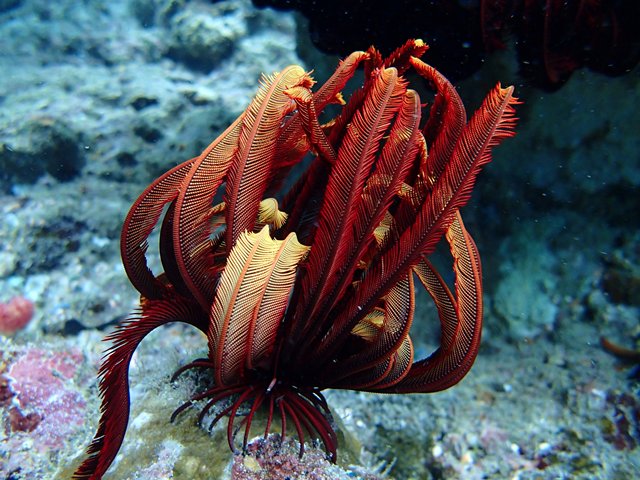
These feathery fans are graceful, but don’t touch, or you’ll be in for a shock! I grazed one by accident, and that was enough to make sure it didn’t happen again. We usually wear stinger suits (for sun protection as much as anything), but the water was so warm here that we were sometimes just in skins.


These beautiful organ pipes stretched up to the sun. This group was covered in worms. To give you a sense of the scale, I believe those worms are as big around as my index finger. Yes, that thing is really big!


A folded crinoid, captured with beautiful delicacy.


Friday, March 22, 2013

Eating our way through Ambon

We’re told that Ambon is looking for a moniker. We met a woman who had worked to promote Ambon as a tourist destination, who said there was some tension between the candidate slogans of “city of music” and “the waterfront city.” We’re not sure how well either of those apply, because for us Ambon will be remembered as “the city of delicious food”.

There was plenty of time to find local haunts, and we had incredible meals at the little rumah makan (restaurants) near the city market.

Rumah Makan Padang 'Ayah'
Arranging fish servings for the window display

I seem to have a lot of photos like this one, capturing the a great spread just before we attack it. These restaurants actually put all of their dishes on your table, then only charge you for those you eat. Dangerous.

Oh yes
Indonesian food is amazing. Oh my goodness, it is just delicious.

We had to try the Muluku staple called pepeda, a porridge goo made from sago (which is made from the pounded heart of tree trunks- hungry yet?). Our new shoreside family made dinner for us one evening so that we could try it along with a range of regional dishes. It’s a good thing we had the other dishes, because pepeda- as one of our shoreside fam referred to it- has all the eating qualities of glue. But the rest? Amazing. Fresh fish with a spicy soy sauce, a heavily spiced fish stew, and more.

Dinner with Pak Hani
Local treats from pepeda (sago mush) to ikan kuah kuning (fish in a turmeric/almond stew)

Here's a charming image of the glue pepeda. Mmmm. Trees.

Jamie tries pepeda

Some indulgences were decidedly less local. At the fancypants mall, the kids inhaled bowls of frozen yogurt. Mmmm…. And then we discovered that the Indonesian restaurant upstairs made chocolate milkshakes and French fries. Trouble!

I was lucky to have another very memorable cooking lesson on board Totem. A conversation with a new friend about how nutmeg is used for savory cooking turned into a lazy weekend afternoon extravaganza on Totem (with their extended family, natch) so they could provide hands-on instruction. Our recipe: Babi Kecap, pork in a rich sauce. It’s somewhat unusual in that pork is less commonly eaten in this predominantly Muslim country, but this region has a significant Christian population...although it took some work to track down the pork. I did the grocery shopping, they brought the knowledge (and their families), and we made a day of it. More, please!

Babi kecap
My fantastic cooking teachers, Ina and Erlyna 

Babi Kecap

2 kg fatty pork (you do not buy "cuts" in the public market. You get a lump of meat)
~ 1/3 c kecap manis (sweet Indonesian soy sauce: sorry, no substitute)
1 Tbsp soy sauce
Salt, oil
~20 cloves garlic
1 med yellow onion
1 bunch green onions / scallions
1 to 2 whole nutmegs

Wash pork, drain well, and cut it into bit-sized pieces. Set aside in a bowl. Add about a tablespoon each of kecap manis and soy sauce, a generous pinch of salt, and about 10 cloves of minced garlic. Stir and let stand for 15-30 minutes.

Chop half of onion and mince 10 cloves of garlic. Fry in a bit of oil (we used coconut) until fragrant, then add pork. Grate in lots of nutmeg- we used about half of a large nut- than splash on a couple of tablespoons of kecap manis. Eventually this will color the sauce to a dark brown color.

Stir over medium heat. My cooking teachers periodically added a bit more kecap manis until they were satisfied with the color and quantity of the sauce. As the pork cooked and rendered fat, this became like a very dark runny caramel.

When pork is nearly done, grate in more nutmeg- we used almost a whole clove. When it is tender and nearly complete, add the other half of the onion (rough chopped into crescent slivers) and scallions (chopped). Cook until these are wilted and mixed in. Cool slightly, then serve with rice.

We ate the entire batch before I could get an "after" photo, and trust me, "before" photos of raw pork just aren't that exciting. I’m told this is even more delicious the second day, but we haven’t made it last that long yet!

New friends
Ina, Erlyna and relatives heading home after our afternoon on Totem

Wednesday, March 20, 2013

Time for a break: parking in Ambon

Sunset- Ambon inner harbor
Peaceful sunsets from Ambon's inner harbor

We've been pressing to keep Totem moving for months. The pressure started before we left Australia: trying to sort out paperwork for departure, making sure we had everything we needed, and then the constant need to make progress so we wouldn't be caught in the adverse conditions of the changing monsoon season. For the first time in many moon, we didn't have to be somewhere, and didn't have the pressure to put miles under the keel in any particular direction.

And so we parked, happily, and enjoyed Ambon for a while. They have two rainy seasons per year, and one ends in January, so we had nice timing to enjoy calm conditions and sunny days.

Ambon was a big cruising destination for years, but the number annual visiting yachts diminished after religious riots started in 1999, dragging on for several years of chaos and senseless deaths. It’s entirely peaceful now, and a handful of boats still do the annual race from Darwin, but the bulk of the international fleet follows the rally path- and their route through Indonesia now goes elsewhere. It’s too bad, because we found a lot to enjoy about Ambon.

We had a sweet anchorage in the inner harbor, off the village of Lateri. Unlike the anchorage off Amahusu used by the rally, in here it's flat as a pancake, good holding, easy depth, and lovely sunset views.


Totem
Totem in the board-flat anchorage of Ambon's inner harbor 

A family on shore let us use their waterfront for a dinghy landing, and became friends in the process. Returning from jaunts to their peaceful neighborhood became like homecoming. They have a "American style" dinner on Totem one evening, and we are treated to a smorgasbord of local dishes at their home on another.


Pak Hani and family
Pak Hani and family on Totem


The market was an easy ride into town. OK, I didn't take these becaks shown below, I took the standard-issue minivan public transportation known as the bemo. But wow, they were awfully photogenic.

becaks

I love the public markets, which are a riot of super fresh produce, sweet smells of overripe fruit, people and vehicles going in every direction at once. This stall is pretty typical, although the staff is usually a little older.

Pasar Mardika

A new-ish mall was a short bemo ride in the other direction. It’s complete with air conditioning, a Starbucks knock-off, and overloud music blasted from clothing stores. A little jarring, and a little welcome. The children loved getting frozen yogurt at J.Co, I loved finding muesli at the supermarket. Something for everyone.

ACC shopping
A counterpoint to the public market

We played tourist, and tootled around the island with a car and driver hired through our new shoreside family: visiting the restored ruins of a Dutch fort, a very old (ca 1400) mosque, and hiking to what we thought was a caldera... but turned out to be a natural dam project.

Sweet ladies at the mosque 
Snagged for photos again...with military wives at the historic mosque

It was a break. We didn't keep a schedule. There were days we lazed around the boat reading instead of tackling things we could/should do. But the decompressing? check. Catching up on life? check. Happy family? check.